
Gemini’s goofy-dragon comeback: can Argon really beat Opus 5.5 and GPT-6 Astra?
林政賢 Zheng-Xian Lin ·
2026-10-20 · TANGYI AI Daily
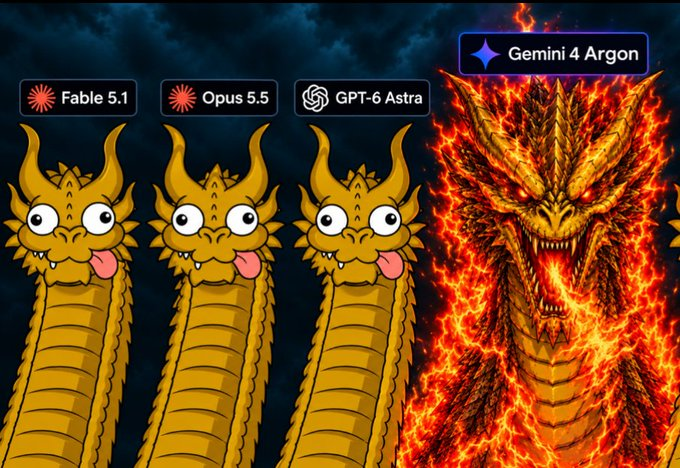
There is a special kind of AI leaderboard where the dragons’ expressions matter more than the numbers. Claude and ChatGPT look fierce; Gemini is often the wide-eyed dragon with its tongue hanging out. While the others look ready for battle, it seems to be there for comic relief.
Now Gemini 4 Argon has arrived with an impressive scorecard, and the meme dragon is suddenly breathing fire. After so long as the funny one, is it finally its turn to lead?
We compared Google’s published results, independent evaluations and public projects you can actually open. The most revealing twist was not simply that one model won. The same Argon model looked much better after its creator changed the tools around it.
Choose a chapter
Google’s report card looks strong. The individual subjects tell a more nuanced story.The same dragon, a different cockpit—and a different result.Enough scorecards. Open the three 3D wind tunnels.The goofy dragon really did go fight a dragon.A contender for the crown. Not an undisputed king.The joke can be fierce. The conclusion can wait.Google’s report card looks strong. The individual subjects tell a more nuanced story.
Google’s September 30 announcement includes a comparison table. Counting its 19 rows, Argon is the sole leader in 13, tied for the lead in one, and behind in five. That describes Google’s selected tests—not a victory across every benchmark in the world. [1]
Even two software-engineering tests change the winner. In Google’s table, Argon leads DeepSWE v1.1, while Astra leads FrontierSWE v2. The kind of work you need done matters more than a universal champion.
The independent Artificial Analysis pages retrieved on October 20 show an Intelligence Index of 58 for Opus 5.5 and 53 for both Argon and Astra. But on AutomationBench-AA, Argon scores 78%, ahead of Opus at 70% and Astra at 68%. [2][3]
These comparisons use Argon High, Opus Max Default Fallback and Astra Max, not an equal compute budget. The Intelligence Index is not a percentage. AutomationBench-AA must not be treated as identical to the AutomationBench row in Google’s chart. Argon has credible strengths; these results do not establish a clean sweep.
| Benchmark | Argon | Astra | Opus 5.5 |
|---|---|---|---|
| DeepSWE v1.1 | 77.9 | 74.1 | 74.2 |
| FrontierSWE v2 | 55.0 | 65.5 | 62.3 |
| LVBench | 91.7 | 87.5 | 83.7 |
The same dragon, a different cockpit—and a different result.
OhMyUnicorn gave the models a fictional warship reference and asked them to write Blender code, render the result and iterate. Astra and Argon were the ship-building competitors; this was not a three-model ship contest. [4]
The initial Argon runs used a Claude Code proxy setup and encountered stalls. The creator then reran Argon through Antigravity CLI. All three reasoning settings completed, and the updated project page judged the high-setting visual result comparable to Astra’s high-setting result.
Astra in Codex CLI took 18.5 minutes at the high setting, producing 156 object parts. Argon’s high-setting Antigravity rerun took 40 minutes and produced 11 parts. More parts do not automatically mean a better-looking model, but structure can matter when you need to edit, separate or rig it.
Looking good, being easy to modify and finishing quickly are different goals. Before calling a model incompetent, ask whether its tools were working properly. The original stall was not conclusively attributed to the model itself.
These are the creator’s individual runs, not our own reruns or a blinded controlled evaluation. Estimated API-price equivalents were about $5.24 and $5.36; Astra was actually used through a subscription, so these were not two cash invoices.
The creator’s tiny-planet project shows a similar pattern: Argon improved after switching to Antigravity CLI and inspecting the rendered page, but the creator still preferred Opus’s close-up detail. Better tools can rescue a result without winning every detail. [5]
Enough scorecards. Open the three 3D wind tunnels.
VisualForge Bench publishes runnable projects with cars, flow lines, cameras and controls. We opened the initial views of all three. These are 3D experiences produced by model-written code—not native Argon-generated video. [6]
Astra’s initial view uses an orange car, a brighter presentation and a right-side control panel. Opus uses a red car with white stripes, a darker wind-tunnel setting and controls on both sides. Argon uses a red-and-black car with yellow detailing, a top telemetry bar and a long right-side control dock.
When you open them, ask three practical questions: Is the subject clear? Do the controls actually change what you see? How easily could you adapt the project to your own brand or product?
Our inspection covered the initial visuals, not every control, mobile behavior, frame rate or physical accuracy. The flow is illustrative, not engineering CFD. Opus’s prompt hash differs from the other two, so this is not an identical-prompt three-way blind test. Some scores on the site use an Opus model judge; we do not use its averages to declare a universal winner.
The linked review video comes from the project’s source page. We retain the original player and link; we have not watched the entire video and do not treat its title as a conclusion.
The goofy dragon really did go fight a dragon.
An October 15 research preprint reports four Argon agents cooperating in a randomly generated Minecraft world and defeating the Ender Dragon. The run took 27 hours and 14 minutes, involved 2,783 programs and included 605 deaths. [8]
The agents controlled characters through the Mineflayer programming interface on Easy difficulty. They were not playing through a human-style screen, keyboard and mouse, and this was not a controlled comparison with Opus and Astra.
The interesting result is persistent planning, coding, coordination and recovery from mistakes over a long task. It does not mean Argon can take over all your work. Still, going from the goofy dragon in a meme to a team that actually defeats a dragon makes a good comeback story.
A contender for the crown. Not an undisputed king.
Argon has strong official results and public work worth examining. Its improvement after a tool change makes it harder to dismiss with a meme. Independent evaluations and creator projects, however, do not show across-the-board domination.
For websites, creative tools and brand assets, ask which model can complete your specific job more reliably. Check whether it delivers, whether the result is usable and whether it survives the next revision.
Use your own materials, the same goal and a similar time budget. Record failures and rework too. That will tell you more than deciding which dragon deserves a crown. Who sticks its tongue out in the next meme? Let them deliver the work first.
The joke can be fierce. The conclusion can wait.
Image searches found several versions casting Gemini as the goofy dragon, but also reversals portraying it as the strongest. ‘Often cast as the goofy dragon’ is more defensible than saying it lost every generation. Memes reflect sentiment, not a historical benchmark record.
Related original posts are linked below. Some X originals were inaccessible to direct retrieval, so we do not infer their publication dates. We did not find a fully verified historical compilation linking every generation, date and measured result.
Sources and further viewing
- blog.google · google ↗
- artificialanalysis.ai · aa-opus ↗
- artificialanalysis.ai · aa-astra ↗
- ohmyunicorn.com · ship ↗
- ohmyunicorn.com · planet ↗
- visualforgebench.com · forge ↗
- www.youtube.com · video ↗
- arxiv.org · minecraft ↗
- x.com · meme1 ↗
- x.com · meme2 ↗
- www.reddit.com · meme3 ↗
- www.anthropic.com · opus ↗
- developers.openai.com · astra ↗
- ai.google.dev · argon-doc ↗
Checked October 20, 2026. This article reviews published evidence and initial project visuals; we did not rerun the three models. Third-party projects and videos stay at their original sources. Benchmarks, availability and rankings may change.
Author:林政賢(Director · Gen AI creator & engineer · Founder of TangYi Studio)