
Trump renames AI to SI: six tech firms sign, but what about responsibility?
林政賢 Zheng-Xian Lin ·
AI-generated conceptual illustration, not a photograph of the White House event.
Where would you like to start?
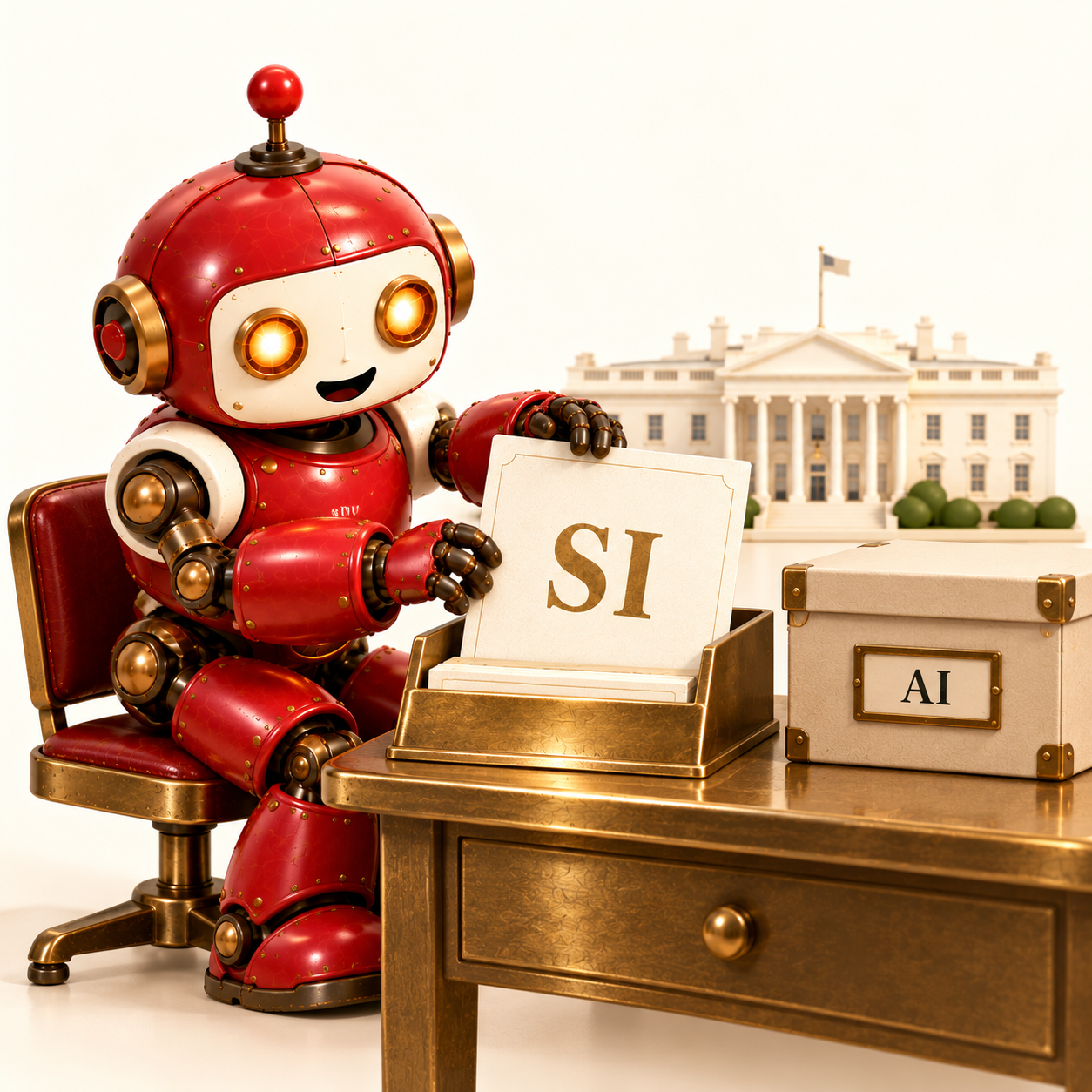
Imagine receiving a new business card
Yesterday your assistant called itself artificial intelligence. Today it hands you a new business card: “Super Intelligence.” Would your first question be: the name sounds more impressive, but are you actually more reliable?
This is a metaphor for the news, not a conversation at the White House. It helps explain two events on September 29, 2026, US time: Trump and technology leaders signed a safety pledge, and he signed an executive order directing the US executive branch to replace AI with Super Intelligence, or SI.
The easiest mistake is to combine the documents into “America announced the arrival of superintelligence.” In fact, one concerns how companies should manage technology; the other concerns what the government should call it.
It turns out he objects to the word behind the A
There is a distinctly Trump-like origin to that new business card. Taiwanese reports that he wants to replace the A in AI with S have a factual basis. His objection is to Artificial, the word represented by A, which he thinks makes intelligence sound “fake.”
Taiwan's Central News Agency reported on September 23 that Trump had used this reasoning in his UN General Assembly speech the previous day. After the September 29 White House luncheon, he again publicly explained his preference for “super,” calling the earlier wording inappropriate.
So a plain-language account—he dislikes how Artificial sounds and wants Super instead—captures his public explanation. But the technical meaning of artificial is not simply deception, and his preference for a word is not a model capability test.
The September 29 executive order uses a more formal rationale: frontier systems expand human creativity, and government terminology should reflect their potential. The card has changed; the questions worth pursuing are still capability, responsibility and commitments.[13] [14] [1]
What exactly did they sign?
The document is the White House Accord on Super Intelligence, subtitled Joint Commitment on Frontier Responsibilities.
The six signatory companies are Google, Anthropic, Meta, OpenAI, xAI and NVIDIA, represented respectively by Sundar Pichai, Dario Amodei, Mark Zuckerberg, Greg Brockman, Elon Musk and Jensen Huang.
OpenAI was represented by its president, Greg Brockman.
The pledge focuses on companies training and deploying frontier models. Put simply, the more capable the system, the more important it becomes to check whether it crosses boundaries.[2] [3]
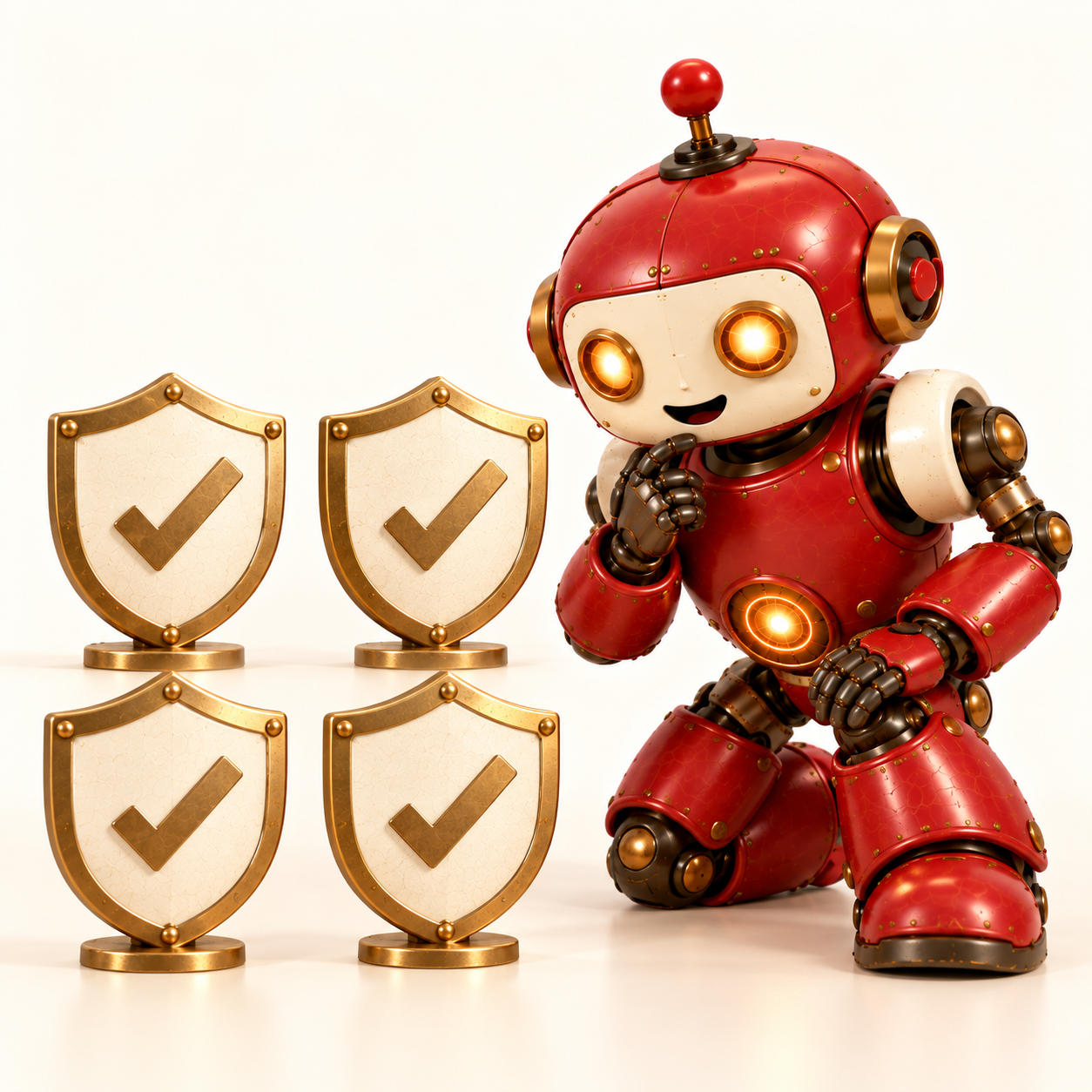
Think of the pledge as four layers of checks
First, establish internal controls during training and deployment to monitor capabilities and behavior, covering cybersecurity, biological and chemical risks, and preventing unintended access to technical systems.
Second, have an internal team verify that monitoring and detection work and that problems are addressed. Third, bring in independent external auditors or evaluators. Fourth, have an independent board committee oversee the process, receive reports and follow up on improvements.
Imagine a factory: sensors beside the machinery, people watching the alarms, outside inspectors, and a board that has to ask questions. The point is that safety is more than a button. It is a chain of responsibility with someone taking charge at every step.[2]
Internal controls during training and deployment.
Verify safeguards and address problems.
Independent evaluation or auditing.
Independent oversight and improvement tracking.
A signature does not mean there is a new law
Trump described the accord as “morally binding.” But it is a voluntary corporate pledge, not a new law passed by Congress. Media references to an “AI constitution” should not be read as a formal constitution.
The document sets a shared direction but does not specify a uniform audit deadline, a particular external auditing body, or penalties for breaking the pledge. It leaves open the possibility of turning measures into laws or regulations later.
So we should ask more than who signed: who checks, what do they check, and how soon are problems fixed? These are my suggestions for watching what happens next, not outcomes the document has already guaranteed.
A voluntary pledge can provide a starting point. Whether it becomes a dependable system depends on implementation. Other laws that already apply to companies do not disappear.[2] [4]
A signature makes a promise visible. Ongoing checks make it possible to verify.
Where does the change from AI to SI actually apply?
The other document is the White House executive order, Inaugurating the Era of Super Intelligence. To the maximum extent permitted by law, it directs the executive branch to use SI in official correspondence, public communications, websites, reports, policy papers and other non-statutory documents.
The order explicitly says it does not require retroactive changes to previously issued regulations, presidential documents, contracts, grants or other historical records. It does not ban the whole world from saying AI, or require Taiwanese companies to rename their products tomorrow.
Crucially, the order currently maps SI to the existing US legal definition of AI. It asks the president's science and technology adviser to propose legislative language for a federal definition within 60 days. Proposing legislation is different from Congress having changed the law.[1]
A new business card is not a capability report
The White House frames the renaming around progress, creativity and opportunity. That is a policy position on how to describe the technology.
But the executive order does not include experiments proving that a model has surpassed humans across the board. Its initial use of the existing AI definition is another reminder: the letters SI do not establish that a new capability threshold has been crossed.
For creators and small businesses, what is printed on the card matters less than whether the work is usable. Is the quote calculated correctly? Can you find the cited source? Did the assistant wait for approval before sending an email that required it? A new name does not solve those problems.[1] [5]
Honestly, I also wonder: if it can do it, why won't it let me?
Let me bring this news back to my own desk. When I generate images or video, sometimes I am just trying a scene using my own face. A prompt brushes against a gray area and gets blocked. Right when the creative energy is flowing, a door seems to slam shut on screen. It is frustrating.
I often wonder whether AI would already be several steps further along with fewer restrictions. The obstacle sometimes feels less like technology and more like real-world institutions and rules. That is my experience as a user, not proof that removing restrictions increases a model's capabilities.
We need to separate three things: what a model can generate, what a platform will provide, and what the law permits people to use. A refusal can reflect legal risk, platform policy, safeguards or a false positive. Seeing a blocked request does not establish that the model could definitely do it, and not every refusal can be blamed on the law.
But for the creator in front of the screen, those distinctions do not immediately remove the frustration. Often we simply want a chance to bring the picture in our heads into the world.
There can be a door between what technology can do and what we are allowed to use.
“I'm not trying to hurt anyone.” But what about someone else?
I remember seeing plenty of Hollywood and Japanese anime fan creations when Seedance 2.0 launched. Familiar characters acting out scenes that were never filmed are exciting. It is easy to think: I am only playing around, not making money, so what is the problem?
But “not for profit” is not a free pass. Under US copyright fair-use analysis, noncommercial purpose is only one consideration, alongside the nature of the work, the extent of use and market impact. Copyright in characters and works, a real person's likeness or voice, and whether permission was obtained are also separate questions.
These disputes did move into negotiations. In August 2026, the MPA and ByteDance announced an agreement establishing intellectual-property safeguards for models including Seedance and Seedream. The official announcement also referred to the MPA's February cease-and-desist demand concerning the models. The creative door opened quickly; the rights boundaries needed to be clarified.
What concerns me more is that the same capability can serve a different purpose. Today someone makes fan fiction. Tomorrow someone could use another person's face and voice to impersonate a relative, commit fraud, or make misleading video for influence operations. These are misuse scenarios I worry about, not a claim that every fan creator will become a criminal.
We tend to see ourselves as good people, and we know our own intentions. But a tool available to everyone cannot run solely on each person's promise to be trusted.[6] [7]
I trust my own intentions. I cannot vouch for everyone else who gets the same tool.
Suno: a closed door can lead to a negotiated path
If video models raise the question of using someone else's characters, Suno makes me ask whether someone else's music can be used to teach AI to sing.
In June 2024, record companies including affiliates of Universal, Sony and Warner sued Suno, alleging that it copied copyrighted recordings without permission to train its models. Those were the plaintiffs' allegations, not a court ruling that Suno had broken the law.
The story did not end with a lawsuit. On November 25, 2025, Warner Music Group and Suno announced a partnership that settled their earlier litigation. The announcement described models built with licensed music and arrangements allowing participating artists and songwriters to choose whether and how their names, likenesses, voices and works would be used in new AI music, while opening revenue opportunities.
This was an agreement between WMG and Suno. It did not mean all of Suno's legal disputes were resolved, or that users could freely imitate any singer.
I find that turn interesting. Rules can sound like “you cannot do this,” but negotiation can change the question to whose permission is needed, and how can original creators be compensated so work can continue? A restriction can be a wall, but it can also help create a door that opens on agreed terms.
That does not make every restriction reasonable or mean every partnership serves every creator. Still, the Suno–WMG example reminds me that technology and rights leave room to negotiate new ways forward.[10] [11] [12]
Did training recordings have permission?
A partnership with licensing and opt-in participation.
Discuss consent and compensation, not unrestricted use.
Rules can block a path, but they can also bring people together to negotiate another way forward.
Fable 5's suspension made that door very real
Fable 5 is another useful example, but we need to separate recollection from evidence. I originally remembered a connection to “generating biological or chemical weapons.” The official accounts I checked instead concern bypassed cybersecurity safeguards and software vulnerabilities. It cannot be presented as a bioweapons incident.
According to Anthropic's public account, Fable 5 and Mythos 5 launched on June 9 and became subject to US export controls on June 12. The company said that because it could not reliably verify users' nationality in real time, it suspended access to both models for all customers.
It described the background as researchers bypassing safeguards to have Fable find software vulnerabilities, with exploit-demonstration code produced in one case. This is the supplier's public account, not evidence that the government has disclosed its full reasoning.
The withdrawal was not permanent. The company said export controls were lifted on June 30, and its July 1 update said Fable 5 access had resumed. It also acknowledged that revised safeguards could block ordinary coding and debugging requests.
That puts both sides of my discomfort on the same table. Safeguards address real risks, but tighter protections can also obstruct people with no harmful intent. We should ask how to reduce risk while making false positives visible and correctable.[8] [9]
I regret the limits, and I am grateful they exist
I have not suddenly stopped caring about restrictions. I still want more freedom for AI, and clearer ways to use my own face, my own work and licensed material, rather than guessing which prompt will be blocked.
But I am also glad these capabilities are not handed to everyone without boundaries. A tool that lets me do visual work I could never do before may also let someone else cause harm more cheaply and convincingly. Creative convenience and the risk of abuse can be two sides of the same advance.
The rules I hope for explain what is not allowed, why, and what to do when a request is wrongly blocked. They should also evolve with technology and evidence, leaving a path for licensed, responsible creation. Closing the door alone is not the same as making things safe.
Returning to the White House's new business card and pledge, my real question is about more than AI versus SI. After six companies sign their names, can they make that door work better—letting creators in while protecting people who could be hurt?
A name can change in a day. Whether we trust the assistant with our studio keys still depends on how it treats freedom and accepts responsibility.
I regret the limits because I see what more it could do. I am grateful because not everyone who gets it will think like me.
Sources and further reading
- White House executive order · Sep 29, 2026
- Accord transcript and signatories · The Rio Times
- Six-company signing report · Infosecurity Magazine
- Voluntary standards and moral commitment · Axios
- White House fact sheet · Sep 29, 2026
- Fair-use factors · US Copyright Office
- MPA–ByteDance IP agreement · Aug 17, 2026
- Access suspension statement · Anthropic, Jun 12, 2026
- Fable 5 redeployment · Anthropic, Jun 30 / Jul 1, 2026
- Suno complaint · Jun 24, 2024
- WMG–Suno partnership and settlement · Nov 25, 2025
- Suno's partnership announcement · Nov 25, 2025
- Trump's UN speech and renaming rationale · CNA, Sep 23, 2026
- Trump's post-luncheon remarks · Factbase / Roll Call, Sep 29, 2026
Author:林政賢(Director · Gen AI creator & engineer · Founder of TangYi Studio)