
GPT-6 Astra, Sol or Luna? Prompts, Games, Work and Travel
林政賢 Zheng-Xian Lin ·
You open AI to get something done. First, the menu asks you to choose Astra, Sol or Luna.
These are probably the questions you actually want answered:
- Which one should write my image prompts?
- Which one should write video prompts and plan shots?
- Which one should help describe a game—or build it?
- What about everyday questions, short translations and messages?
- Which one should prepare work documents, reports and presentations?
- Which one should plan a trip for the whole family?
Here is a useful starting point:
| What you want to do | Try first | Why |
|---|---|---|
| Write image prompts | Sol | Turn your subject, composition, lighting and intended use into a complete brief |
| Write video prompts and shots | Sol | Describe actions, camera movement and timing clearly |
| Describe a game or build a playable first version | Sol | Work through the rules and implementation step by step |
| Simple questions, short translations and messages | Luna | Handle a small, clearly defined task |
| Documents, reports and presentations | Sol | Organize your material into a draft you can edit and use |
| Travel itineraries | Sol | Consider dates, locations, budget and travelers together |
When does Astra come in? Consider it when several things need to work together: shots must connect, game systems affect each other, or a trip involves multiple cities, older relatives, children and fixed transport times.
The next six sections answer those questions: where to start, what to ask, and when another model may help.
These are practical recommendations based on OpenAI's model positioning, not task-by-task benchmark results. Information checked September 23, 2026.
Which model should write image prompts?
Start with Sol when you need to describe a picture from scratch. Explain the subject, setting, lighting and intended use. That is more useful than asking for an “amazing prompt.”
For a café advertisement, describe the cup, its surroundings, the image orientation and where the headline needs space.
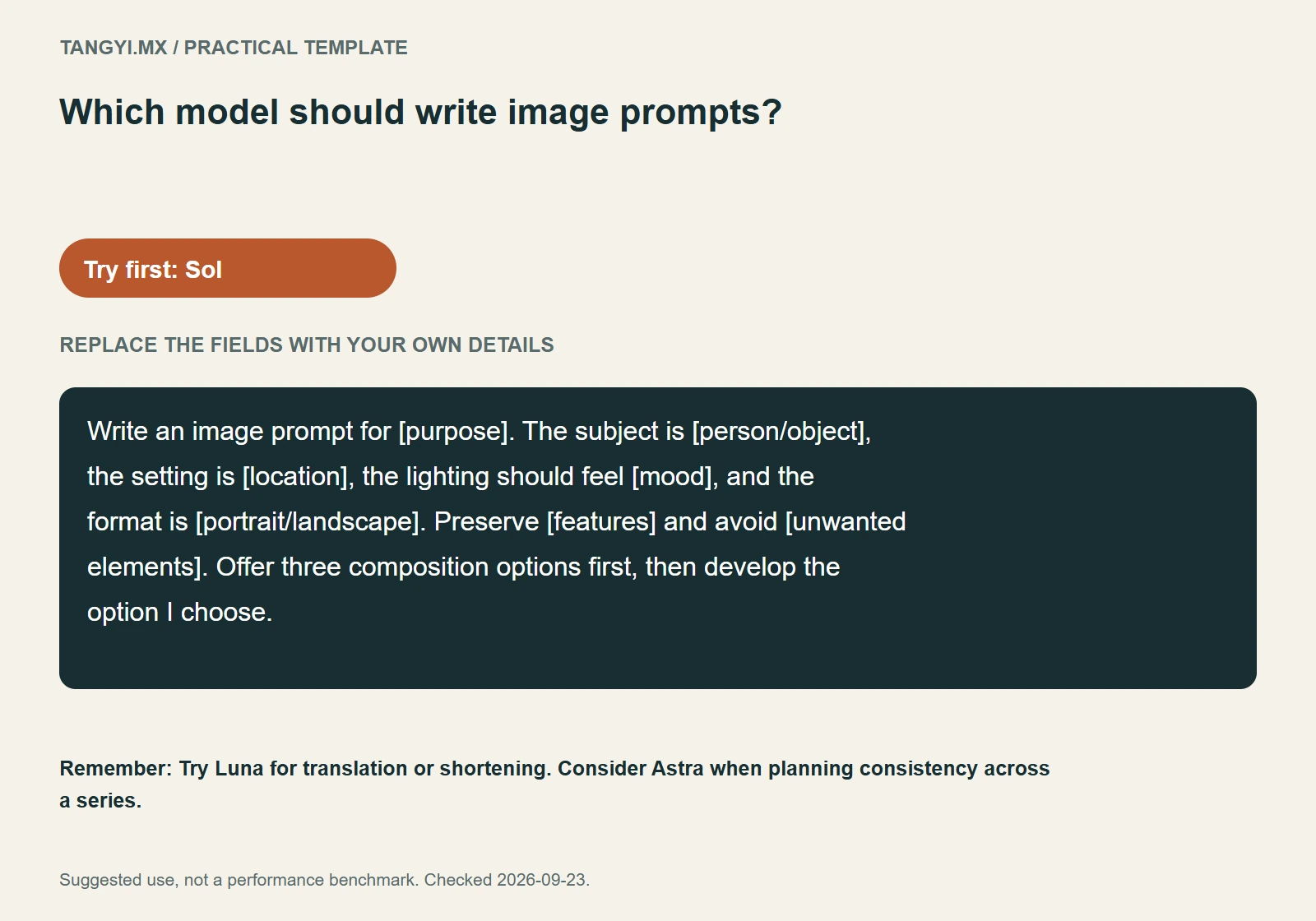
The visual gives a concrete example. Replace the [fields] below with your own requirements.
Template to reuse:
Write an image prompt for [purpose]. The subject is [person/object], the setting is [location], the lighting should feel [mood], and the format is [portrait/landscape]. Preserve [features] and avoid [unwanted elements]. Offer three composition options first, then develop the option I choose.
If your prompt is already complete and you only want an English translation, fewer words or consistent fields, Luna is a reasonable starting point. For ten images of the same character, Astra can help plan how clothing, props and lighting connect.
We are talking about writing prompts and organizing visual requirements. The actual image also depends on the image model, reference images and settings. Choosing Astra does not guarantee character consistency.
Which model should write video prompts?
Try Sol for a single shot or a straightforward short video. Video adds time: who does what first, where the camera moves, and what the final frame looks like.
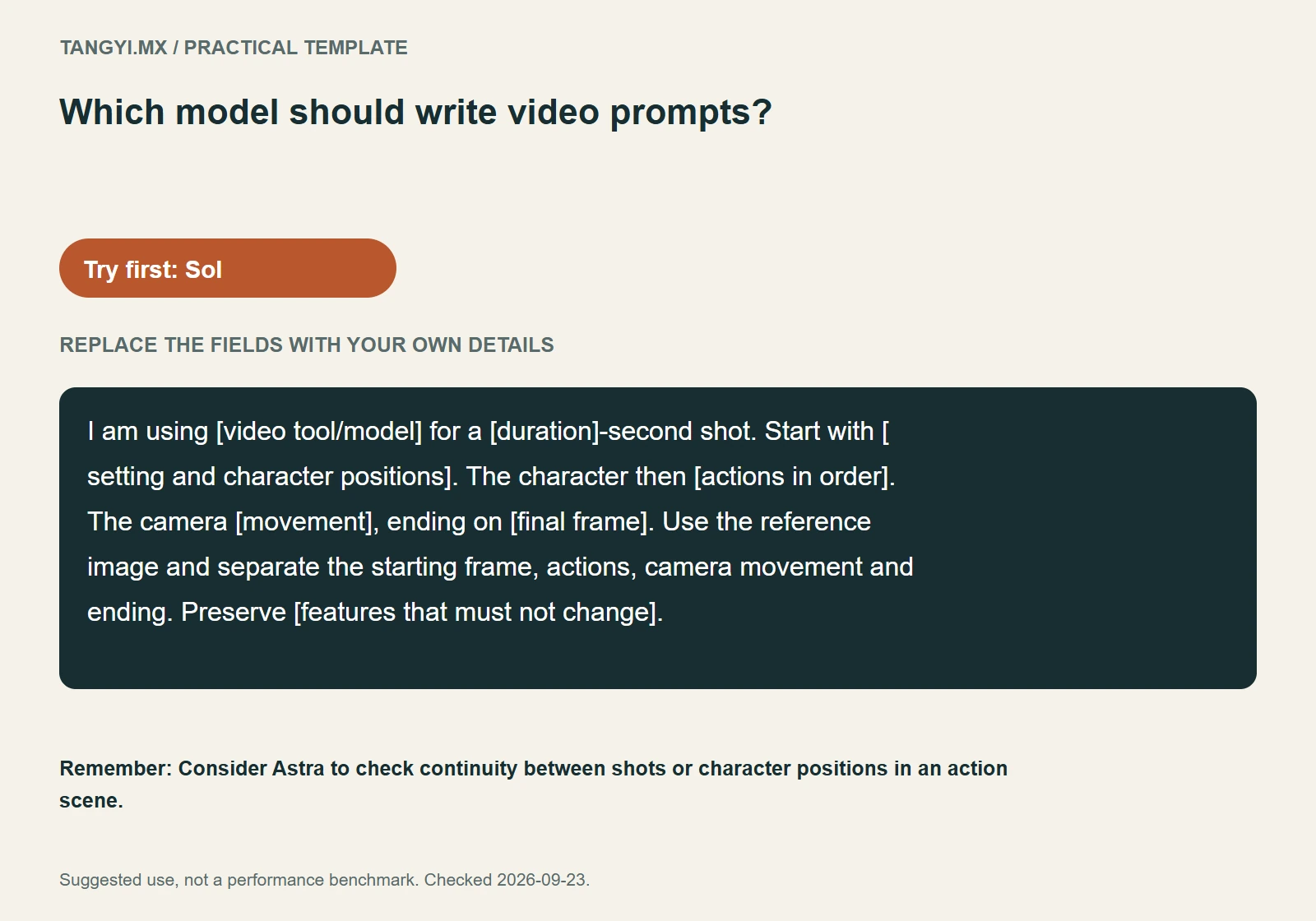
Use the example in the visual, then adapt the fields below.
Template to reuse:
I am using [video tool/model] for a [duration]-second shot. Start with [setting and character positions]. The character then [actions in order]. The camera [movement], ending on [final frame]. Use the reference image and separate the starting frame, actions, camera movement and ending. Preserve [features that must not change].
For a fight, chase or two clips that must form one scene, Astra can help examine difficult connections: did someone change position unexpectedly, where did a prop go, and can one action lead into the next?
Luna can organize approved material into shot numbers, durations, characters and prompt fields. Confirm the content before processing it in bulk.
You still need to watch the generated footage. The model pages distinguish text output from separate media tools; planning a video is not the same as delivering a finished video. Astra specifications, Sol specifications, Luna specifications
Which model should describe or build a game?
Try Sol for the game brief and the first small playable version. Explain what “playable” means so you can judge the result.
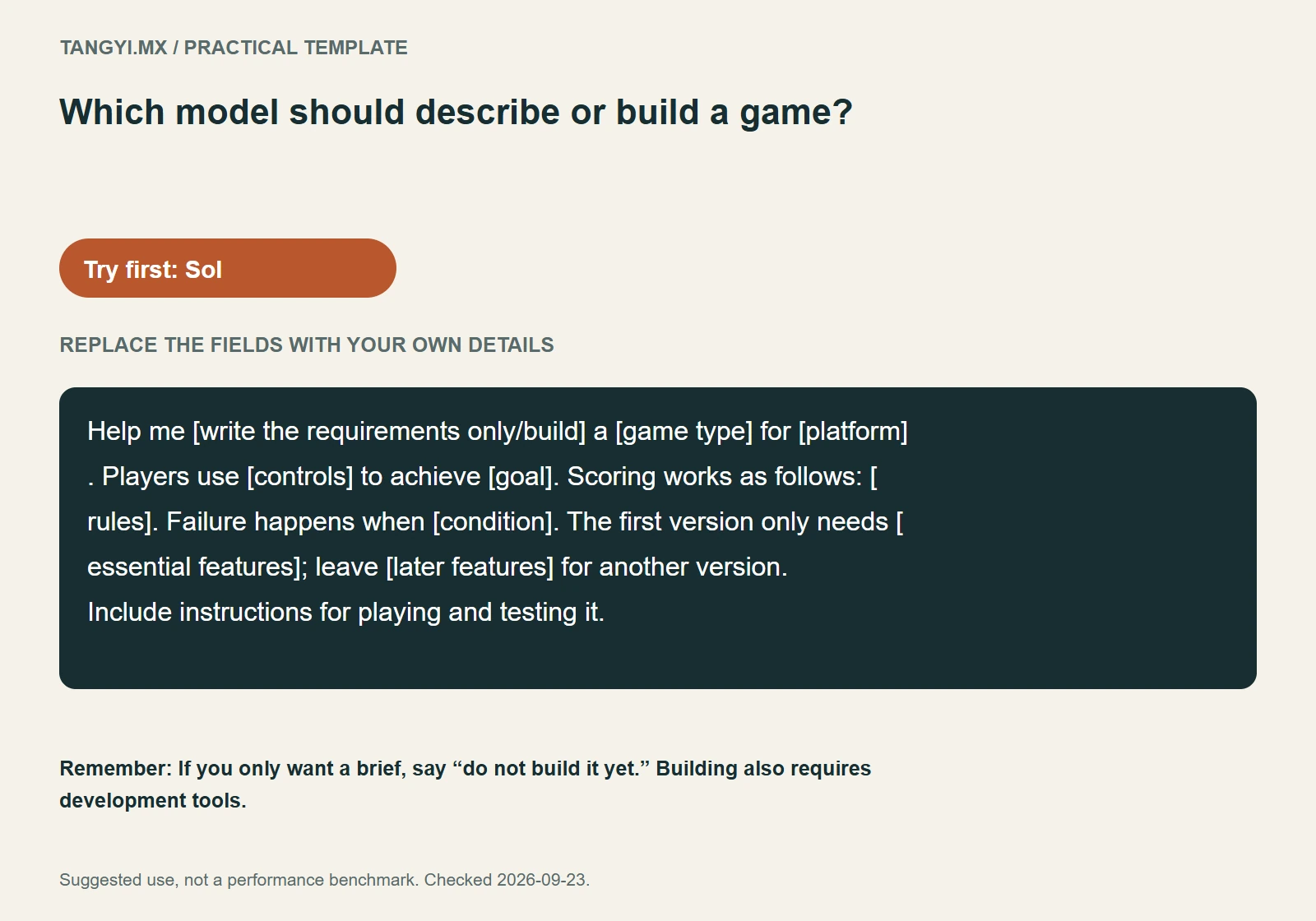
The example uses a simple fruit-catching game. Replace the fields for your own game.
Template to reuse:
Help me [write the requirements only/build] a [game type] for [platform]. Players use [controls] to achieve [goal]. Scoring works as follows: [rules]. Failure happens when [condition]. The first version only needs [essential features]; leave [later features] for another version. Include instructions for playing and testing it.
If all you want now is a prompt, explicitly ask for requirements without implementation. To build the actual game, the environment needs tools to edit files, run code and test it.
Luna can help with character descriptions, item names, button labels or approved level data. As equipment, abilities, saved games or multiplayer features interact, consider Astra to review the design or investigate difficult bugs.
Make one level playable before adding more. “Build a huge RPG” leaves too many decisions unstated.
Do everyday questions and messages need Astra?
Try Luna for a simple explanation, short translation or change of tone. Examples include explaining a phrase, making a message more polite or turning a paragraph into three points.
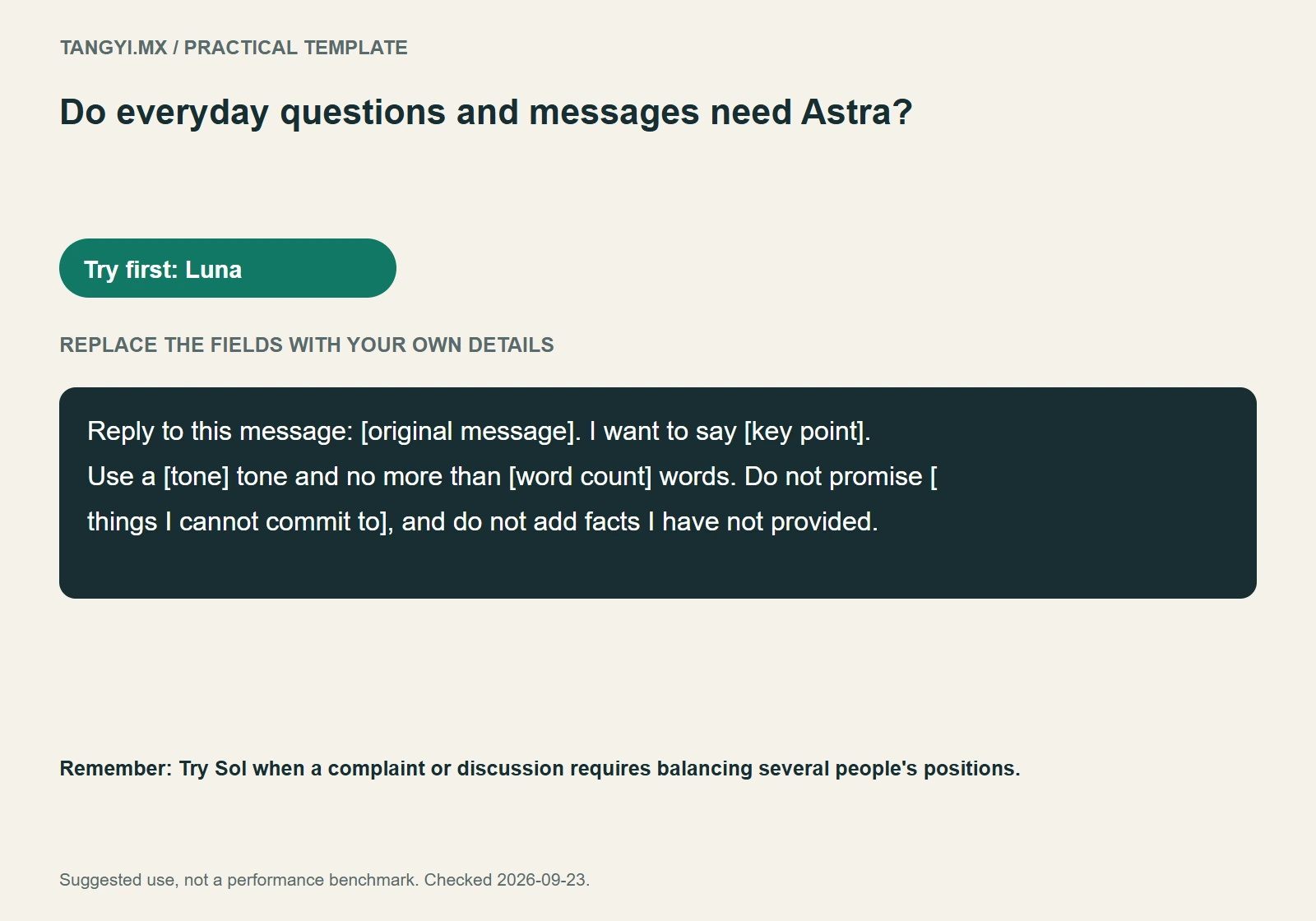
The visual illustrates a polite reply without making extra promises.
Template to reuse:
Reply to this message: [original message]. I want to say [key point]. Use a [tone] tone and no more than [word count] words. Do not promise [things I cannot commit to], and do not add facts I have not provided.
If the task becomes “compare three options with different constraints,” Sol is worth trying. Consider Astra when there is substantial evidence or conflicting conditions.
Length is not a reliable measure of difficulty. “Should I change jobs?” can involve more judgment than translating a page of text.
Which model should prepare work documents?
Try Luna to organize existing material, and Sol to produce a complete document. Consider Astra when you must weigh competing options or reconcile conflicting sources.
After a meeting, Luna can extract decisions, owners and deadlines. Turning those notes into a client proposal—with a structure and an explanation of the approach—is a good task to try with Sol.
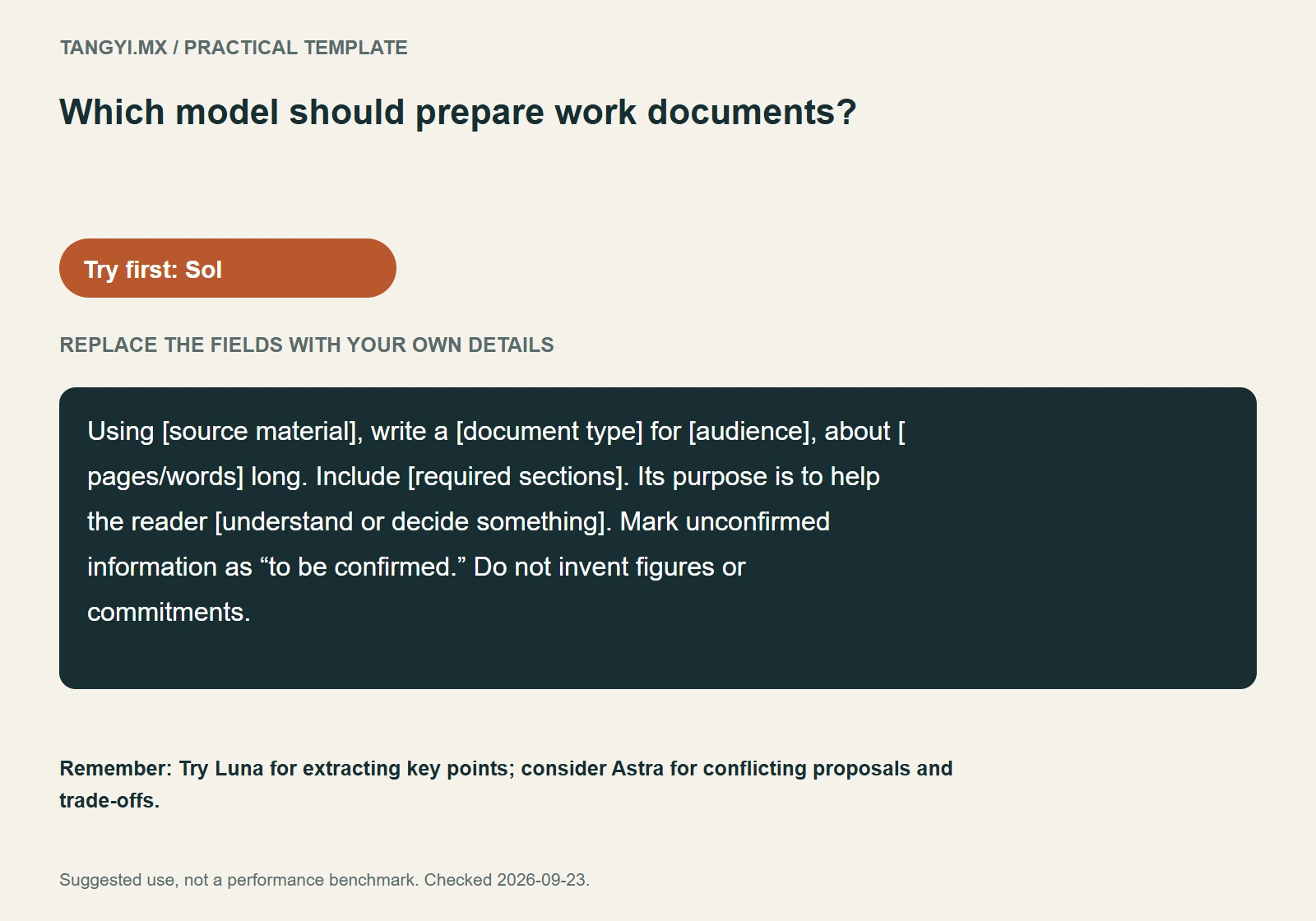
The visual uses a two-page client proposal as its example.
Template to reuse:
Using [source material], write a [document type] for [audience], about [pages/words] long. Include [required sections]. Its purpose is to help the reader [understand or decide something]. Mark unconfirmed information as “to be confirmed.” Do not invent figures or commitments.
For a presentation, ask for one point per slide and accompanying speaker notes. If you need an actual Word, PowerPoint or Excel file, your environment must support creating that file. Model choice and file-generation tools are separate considerations.
Which model should plan a trip?
Try Sol for an itinerary with dates, a budget and preferences. Luna can prepare a packing list or put an already-confirmed itinerary into a table.
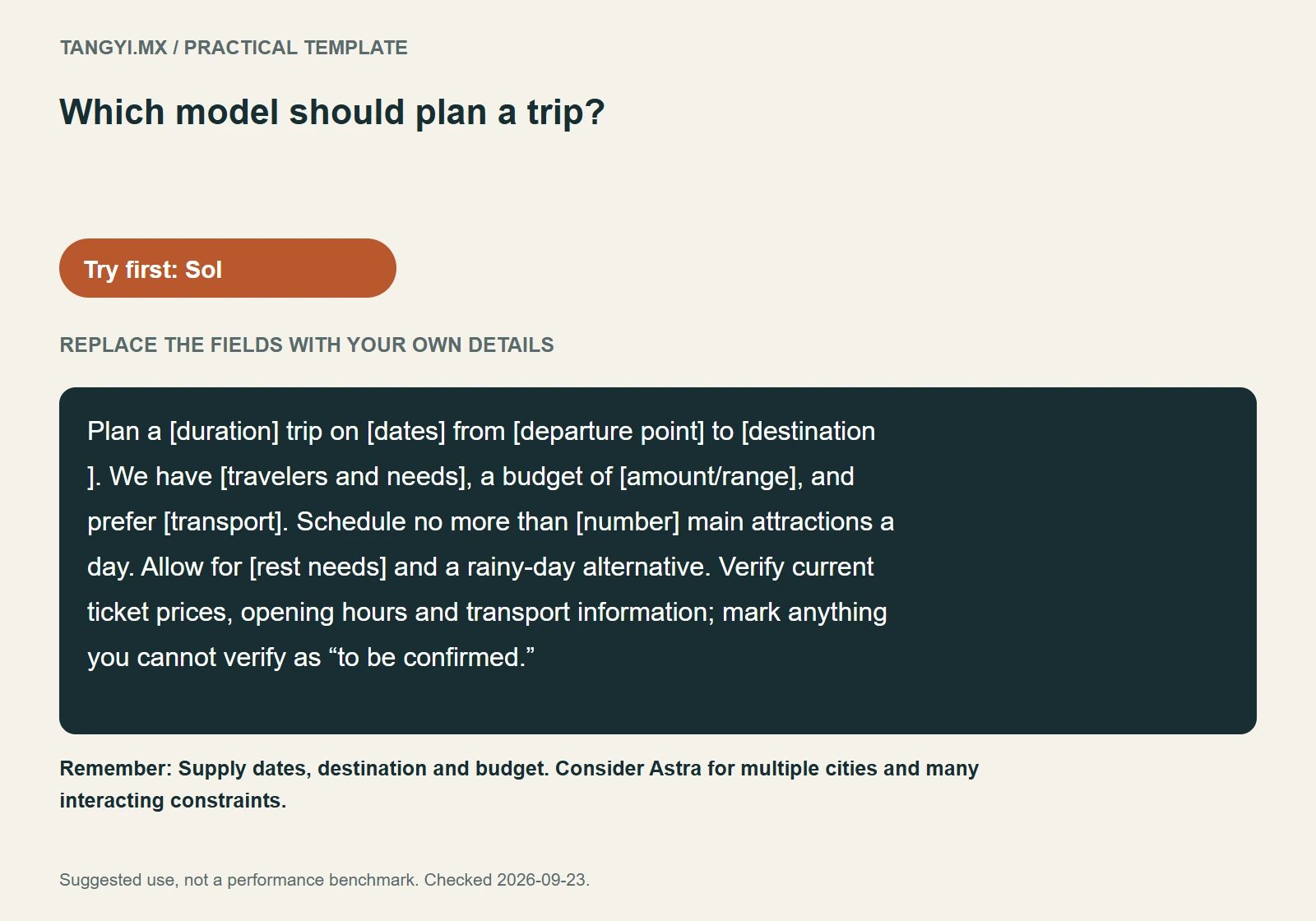
The visual illustrates five days and four nights with two adults and one child, without renting a car.
Template to reuse:
Plan a [duration] trip on [dates] from [departure point] to [destination]. We have [travelers and needs], a budget of [amount/range], and prefer [transport]. Schedule no more than [number] main attractions a day. Allow for [rest needs] and a rainy-day alternative. Verify current ticket prices, opening hours and transport information; mark anything you cannot verify as “to be confirmed.”
If the trip must account for older relatives' walking limits, a stroller, fixed train services and different interests across several cities, Astra can help compare alternatives.
Provide the travel dates, departure point, budget and travelers' needs before planning. Hotel prices, transport times and opening hours require separate verification. An attractive itinerary is not proof that the details are correct.
What else can you use them for? Twenty everyday situations
Try Luna for small, clear tasks; Sol for complete writing, planning and making; Astra for many interacting conditions. “Try first” is a starting point, not a restriction on what the other models can do.
| What you need | Try first | Example request | When to reconsider |
|---|---|---|---|
| Everyday knowledge or a definition | Luna | Explain this term for a teenager | Try Sol/Astra for causes or conflicting evidence |
| Messages and short emails | Luna | Make this reply more polite | Try Sol for complaints, deadlines and several viewpoints |
| Short translation and proofreading | Luna | Translate naturally, preserving names and numbers | Try Sol for brand voice or consistency in a long text |
| Image prompts | Sol | Turn my visual idea into a clear description | Luna for formatting; Astra for planning a consistent series |
| Video prompts and shots | Sol | Describe actions, camera movement and duration | Astra for continuity, action positions and plot connections |
| A game-development brief | Sol | Specify controls, rules and winning conditions | Astra when several systems affect one another |
| A playable small game | Sol | Build a version with a start and restart | Astra for saves, multiplayer or difficult bugs |
| Meeting notes and work emails | Luna | Extract decisions, tasks, owners and deadlines | Sol to reconcile several meetings |
| Proposals, plans and reports | Sol | Draft objectives, approach and schedule | Astra to compare alternatives and risks |
| Presentation content and scripts | Sol | Give each of ten slides one main point | Astra for conflicting evidence or restructuring an argument |
| Spreadsheet organization | Luna | Extract dates, items and quantities | Sol for several tables, formulas and cleaning workflows |
| Résumés and interview practice | Sol | Match my real experience to this role | Luna for shortening or formatting |
| Travel itineraries | Sol | Plan around days, budget and travelers | Astra for many cities or transport and family constraints |
| Packing and shopping lists | Luna | List missing items based on what I own | Sol to coordinate shopping, cooking and time |
| Study plans | Sol | Plan around my level and daily time | Luna for a definition or vocabulary practice |
| Blog, social and product copy | Sol | Draft for this audience using these sources | Luna for short variants; Astra for positioning and strategy |
| Events, weddings and classes | Sol | Organize schedule, materials and responsibilities | Astra to compare venue, staffing and alternative plans |
| Product or tool comparisons | Sol | Compare against my needs and cite sources | Astra for integration and maintenance constraints |
| Websites and features | Sol | Build the page and check mobile operation | Astra for repeated failures involving several parts |
| Large sets of documents | Luna | Summarize and categorize with fixed fields | Astra for contradictions and conclusions across documents |
Current prices and product information require up-to-date research. Switching models does not itself verify a fact.
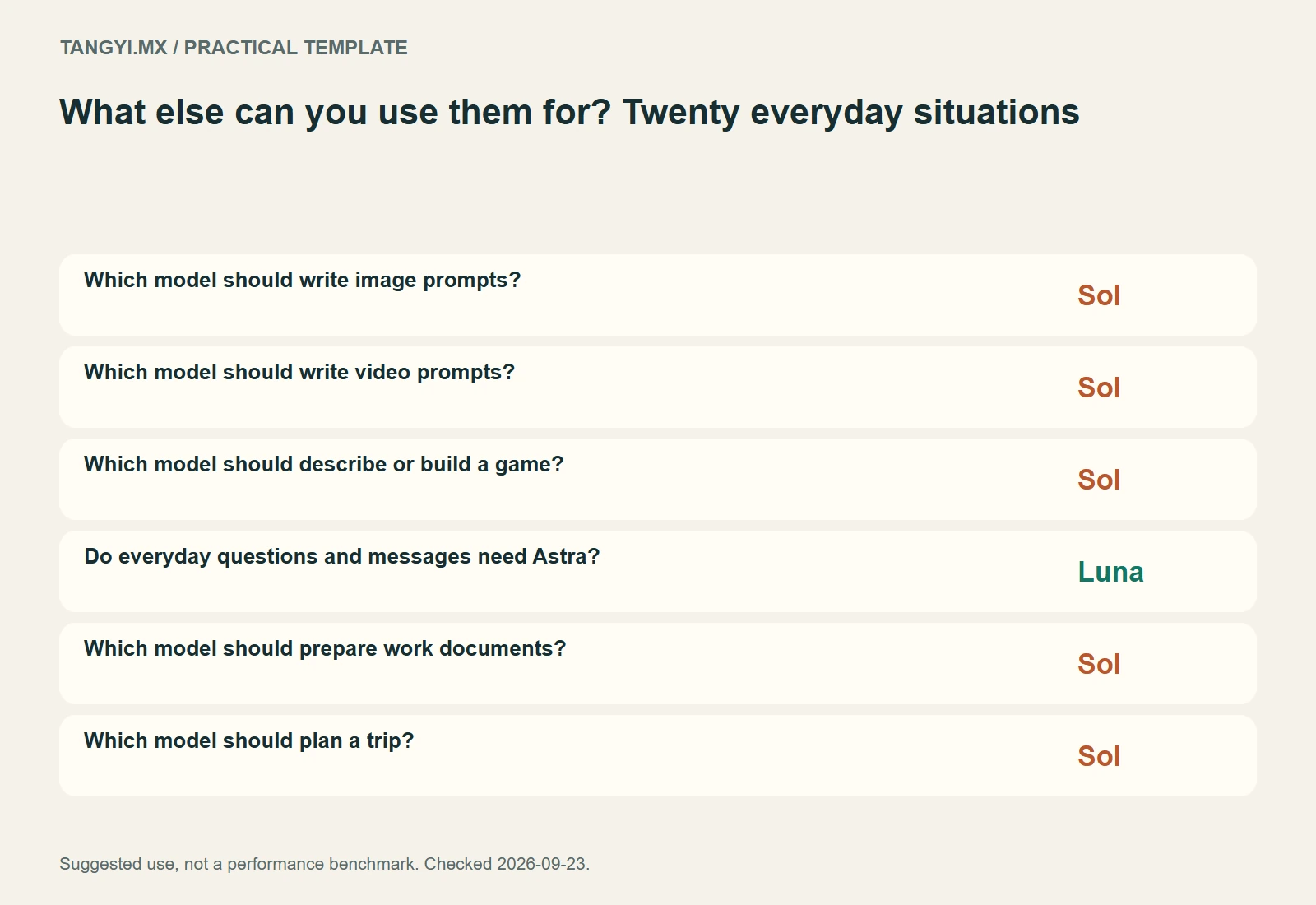
Suggested starting points, not exclusive assignments.
How can you remember the difference?
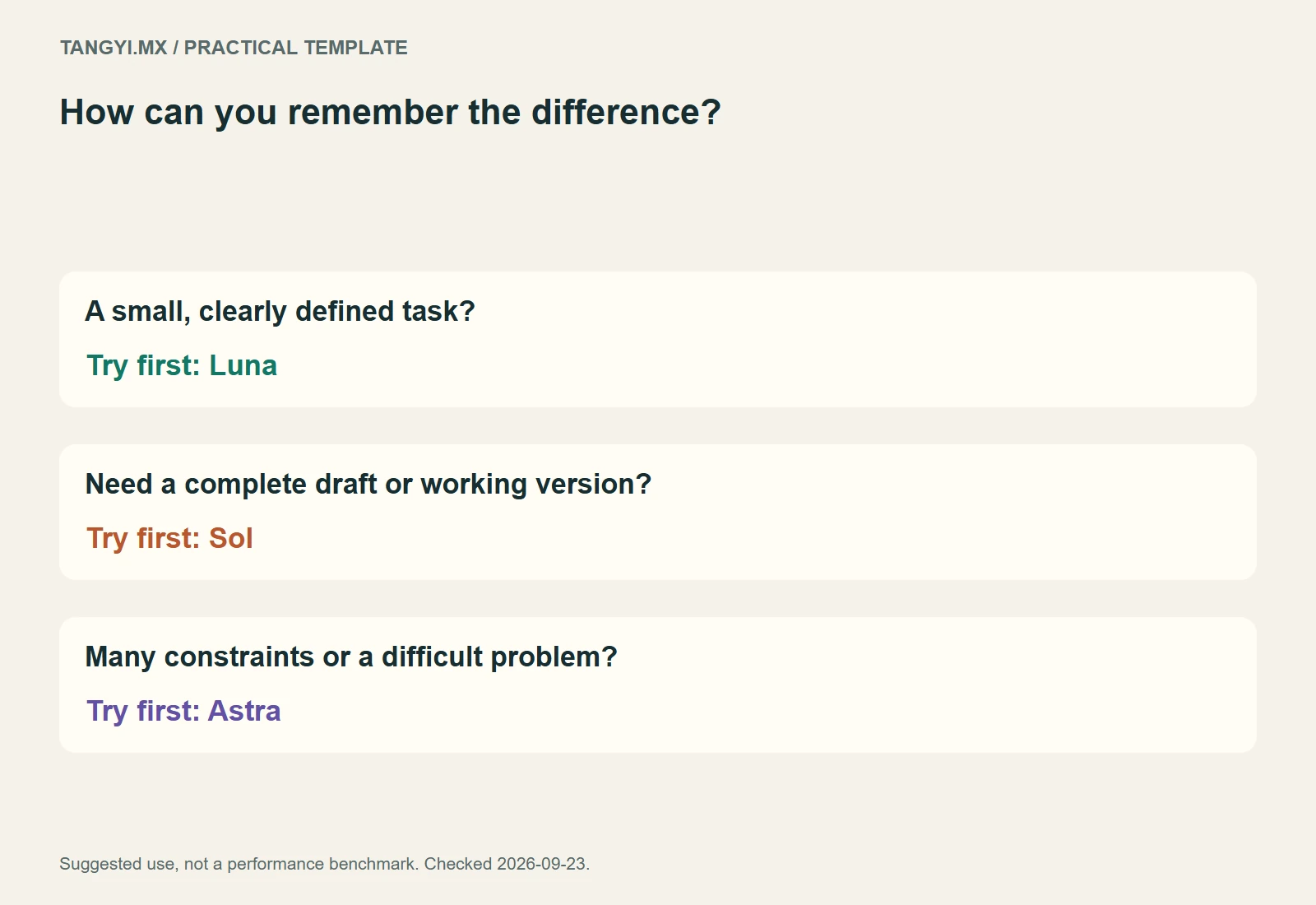
Luna: organize this for me. Sol: make me a complete draft. Astra: help me think this through.
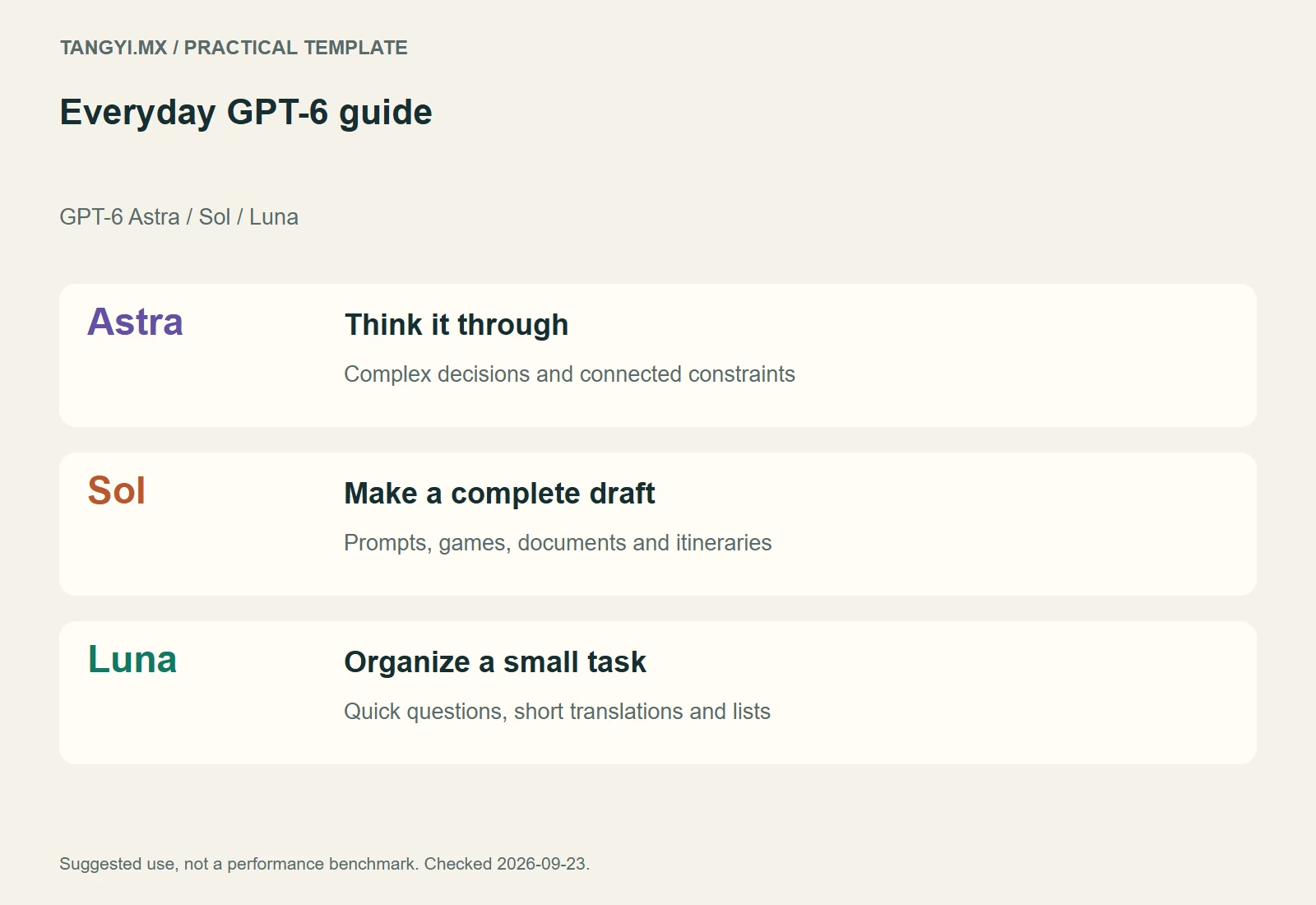
These are memory aids; the models' capabilities overlap.
A clear request makes the result easier to judge. “Write a report” is vague. “Two pages for my manager, with three options and their trade-offs” gives useful direction.
Explain the intended use and constraints before you start.
Can you switch models partway through?
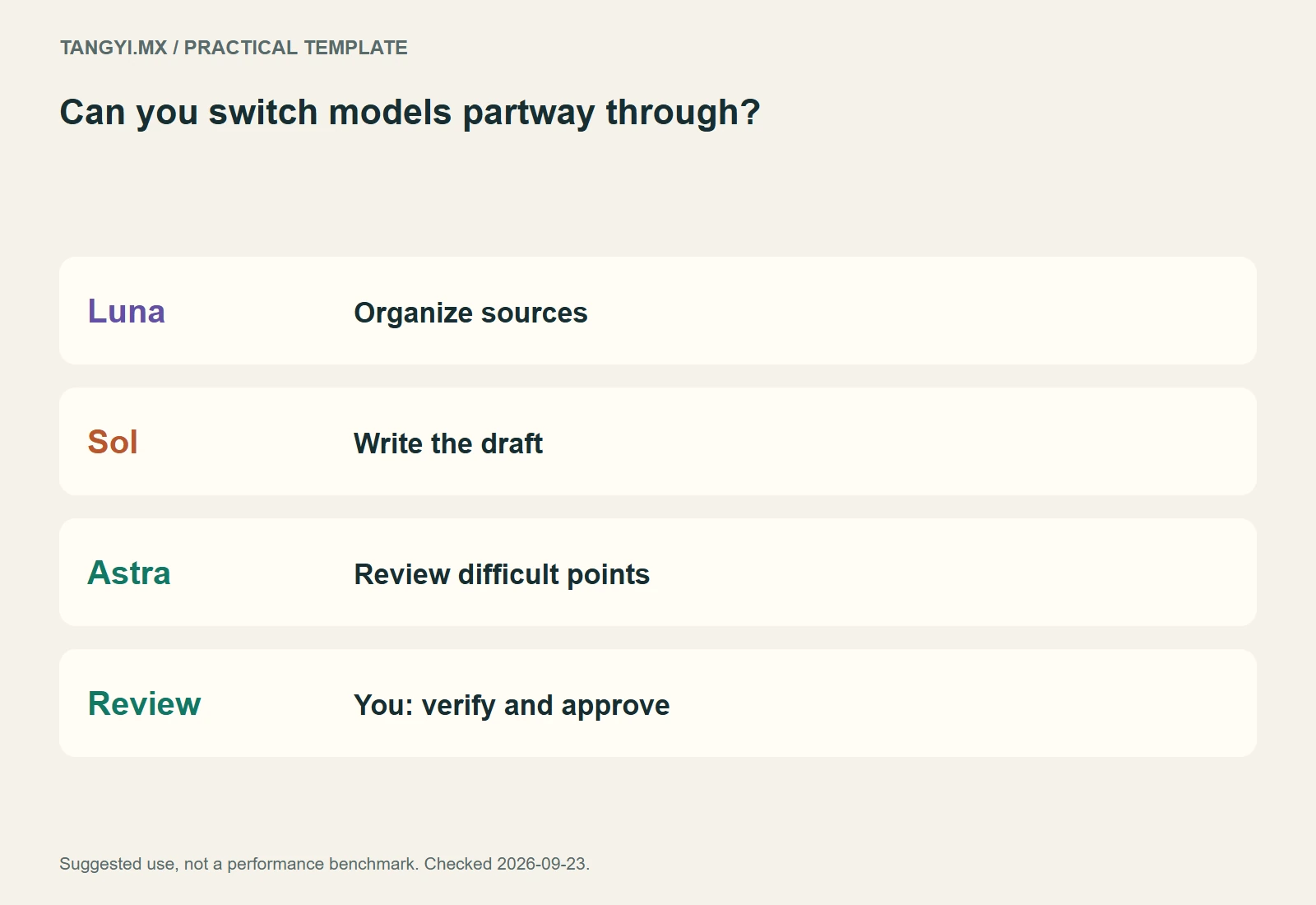
Yes, but pass the underlying material along too. For an article, Luna might organize sources, Sol draft it, and Astra help examine a difficult claim when needed.
If one model is already doing the job well, there is no need to cycle through all three.
Carry over original sources, decisions already made and unresolved questions. Check for missing reference images, files or instructions before asking the next model to continue.
Should you turn reasoning effort all the way up?
Start with the default and increase it when deeper analysis is useful. OpenAI says higher reasoning effort can help complex tasks, but takes more time and uses more tokens. Official settings guidance
Editing a short reply rarely calls for extensive setup. Comparing three proposals and finding overlooked conditions is a better reason to invest in deeper analysis.
How should ordinary users think about cost?
For subscription use, check your account's usage page. For API integrations, use the rates below. An API lets software call the model; its billing should not be confused with choosing a model in an app under a subscription.
If you only needed a recommendation for prompts or documents, you can start now. The following section is for estimating programmatic usage.
How do the GPT-6 API prices compare?
As of September 23, 2026, Standard short-context API rates differ substantially. All values below are US dollars per million tokens. Tokens measure model input and output; they are not a direct count of words or Chinese characters. Official API pricing
| Model | Input | Cached input | Output |
|---|---|---|---|
| GPT-6 Astra | US$10.00 | US$1.00 | US$50.00 |
| GPT-6 Sol | US$2.00 | US$0.20 | US$10.00 |
| GPT-6 Luna | US$0.10 | US$0.01 | US$0.50 |
These are Standard rates for requests with no more than 272,000 input tokens. Long context, Batch, Flex, Fast mode, cache writes and some regional processing have different rates. Astra details, Sol details, Luna details
For a hypothetical 1,000 requests, each using 10,000 uncached input tokens and 2,000 billable output tokens, the total is US$2 for Luna, US$40 for Sol and US$200 for Astra.
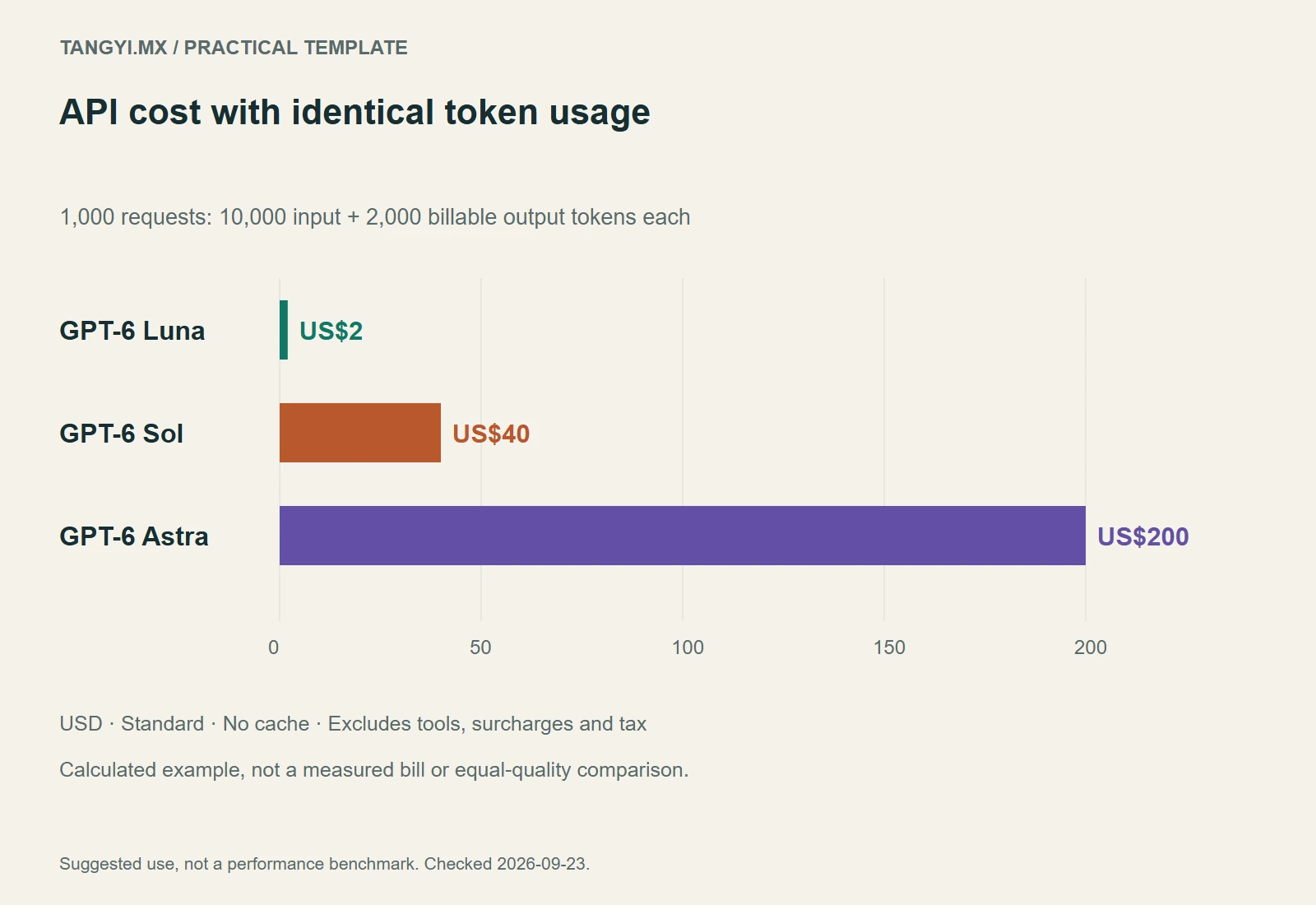
Calculated example, not a measured bill. Standard processing, no cache; excludes tool charges, additional surcharges and taxes.
The example holds token counts constant. It does not establish equal quality: actual tasks may require different output lengths, retries and editing time.
Track the total cost and time required to produce an acceptable result.
If you use Codex or Work through a ChatGPT subscription, check its usage limits and credit rules. The API dollar table cannot tell you how many questions your monthly subscription includes. Credit rates alone also do not determine included subscription usage. Official Work/Codex pricing
Why can't I see Sol or Luna in ChatGPT?
Check whether you are in Work or Codex and whether access has reached your account. OpenAI's September 22, 2026 announcement describes their gradual rollout to those surfaces. They are not model options in ordinary Chat; availability also depends on plan and workspace settings. Official changelog
“Everyday questions” describes a type of task. It does not mean every ChatGPT chat interface offers all three models.
Still unsure? Start with the task in front of you
Try Luna for a small task, Sol for a complete deliverable and Astra for a difficult problem with many conditions.
Write three things: what you want to do, what must not change, and who will use the result. Pick a model, then judge whether its output is useful.
For your next image prompt, start by supplying the reference image, intended use and features that must stay the same.
Related reading
Author:林政賢(Director · Gen AI creator & engineer · Founder of TangYi Studio)